2026 Icons
- Giorgio Armani
- Gabriel Attal
- Alvin Baltrop
- Frieda Belinfante
- Michael Bennett
- Rachel Crandall-Crocker
- Barry Diller
- Ernestine Eckstein
- Laïla El-Métoui
- Edward Enninful
- Andrea Gibson
- Marsden Hartley
- Muhsin Hendricks
- Patricia Highsmith
- Robert Joffrey
- Julie Johnson
- Lani Ka’ahumanu
- King James I
- Calvin Klein
- Abraham Lincoln
- Chris Pappas
- Pauline Park
- Paul Rudolph
- Amber Ruffin
- St. Vincent
- Jessica Stern
- Charles Sumner
- Jewel Thais-Williams
- Karl Heinrich Ulrichs
- Alok Vaid-Menon
- Edmund White
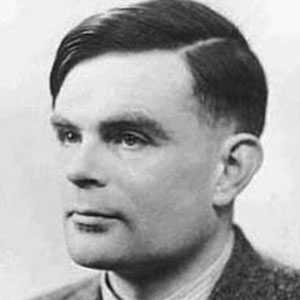
Alan Turing
2006 Icon
Mathematician
b. June 23, 1912
d. June 7, 1954
"I believe that at the end of the [20th] century . . . one will be able to speak of machines thinking without expecting to be contradicted."
Alan Turing led the British codebreaking team that cracked the German Enigma Code, thereby helping the Allies win World War II. He is considered the father of computer science.
Turing was by nature skeptical and indifferent to conventional values. While often at odds with authority, he made remarkable connections between apparently unrelated areas of inquiry, including treating symbolic logic as a new area of applied mathematics.
In 1936, as a fellow at King's College, Cambridge, Turing wrote "On Computable Numbers," his landmark paper, which is considered the founding work of modern computer science. After completing doctoral work at Princeton University, Turing returned to Britain in 1938, shortly before the outbreak of the Second World War.
Turing's potential ability as a codebreaker was identified, and he was introduced to the secret operations at the Government Codes and Ciphers School in London. On September 4, 1939, the day after Britain declared war on Germany, Turing reported to work at Bletchley Park, Britain's codebreaking center. He led the team that broke the German codes, thereby assuring success for the Allies and shortening World War II. His story became the subject of the 2014 Oscar-winning biographical film, "The Imitation Game," starring Benedict Cumberbatch as Turing.
At the conclusion of the war, Turing's ambition was to create a computer. His contention that the computer could rival the computing power of the human brain correctly anticipated the field of Artificial Intelligence.
In the postwar years, Turing competed as a distance runner, reaching near-Olympic times in the marathon. Asked why he engaged in such demanding training, he replied, "I have such a stressful job that the only way I can get it out of my mind is by running hard."
Turing lived at a time when homosexuality was regarded as a mental illness and homosexual acts were illegal. Despite his critical wartime role, when his relationship with a Manchester man became public, he was charged with "gross indecency" and forced to accept hormone treatment with estrogen. He lost his security clearance and suffered physical, emotional, and cognitive effects from the treatment.
Turing died in 1954, shortly before his 42nd birthday, after eating a cyanide-laced apple. His death was ruled a suicide.
In 2009, the British Prime Minister apologized for the government’s inhumane treatment of Turing. Years later, under legislation known as "Turing's law," the British government granted pardons to thousands of men convicted of crimes related to their sexuality. In July 2019, the Bank of England announced that Alan Turing will be the new face of the 50-pound British bank note, which is expected to enter circulation by the end of 2021.