2026 Icons
- Giorgio Armani
- Gabriel Attal
- Alvin Baltrop
- Frieda Belinfante
- Michael Bennett
- Rachel Crandall-Crocker
- Barry Diller
- Ernestine Eckstein
- Laïla El-Métoui
- Edward Enninful
- Andrea Gibson
- Marsden Hartley
- Muhsin Hendricks
- Patricia Highsmith
- Robert Joffrey
- Julie Johnson
- Lani Ka’ahumanu
- King James I
- Calvin Klein
- Abraham Lincoln
- Chris Pappas
- Pauline Park
- Paul Rudolph
- Amber Ruffin
- St. Vincent
- Jessica Stern
- Charles Sumner
- Jewel Thais-Williams
- Karl Heinrich Ulrichs
- Alok Vaid-Menon
- Edmund White
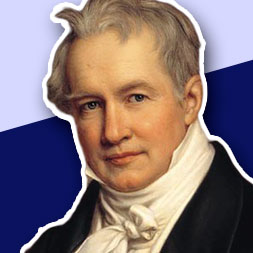
Alexander von Humboldt
2020 Icon
Father of Ecology
b. September 14, 1769
d. May 6, 1859
“The most dangerous worldview is ... of those who have not viewed the world.”
Alexander von Humboldt was a renowned Prussian naturalist, explorer, and geographer, and the preeminent scientist of his time. Regarded as the father of ecology, he laid the foundations for modern biogeography and meteorology and shaped the concept of climate zones, weather forecasting and the theory of man-made climate change.
Von Humboldt was born into a wealthy Prussian family. In 1791, as a compromise between his mother’s desire for him to become a civil servant and his own interest in science and geology, he enrolled at the Mining Academy at Freiburg. As a mining inspector, he investigated the effect of light exposure on wildlife, collected thousands of botanical specimens and invented a breathing mask.
The death of his mother and his inheritance in 1796 enabled von Humboldt to fulfill his dream of traveling the world. Along with Aimé Bonpland, a botanist, he explored Latin America for five years. He landed in modern-day Venezuela, where he traversed rainforests, crossed the Orinoco River and ascended the Andes mountains. He suffered intense cold, braved earthquakes and conducted life-threatening experiments with electrical eels. He returned with notebooks full of geological and meteorological observations and more than 60,000 plant specimens.
At Venezuela’s Lake Valencia, von Humboldt first developed the idea of human-induced climate change. He was the first to describe the fundamental impact of the forest on ecosystems and climate. On Mount Chimborazo, von Humboldt had an epiphany: he reasoned that the world was a single, interconnected organism. His view that ecosystems were intrinsically linked contrasted with previous scientific classifications of the earth and transformed the way scientists viewed nature.
Von Humboldt’s published works on nature made a far-reaching, interdisciplinary impact on major 20th and 21st century thinkers. His concepts inspired the young Charles Darwin to travel and informed his ideas on natural selection. Von Humboldt’s views prompted the revolutionary Simón Bolívar to assert that they had awakened the South American people to take pride in their continent. Von Humboldt influenced great writers such as Goethe, Whitman and Poe, and provided the scientific undergirding upon which modern environmentalists—from George Perkins Marsh to John Muir—built their ideas.
Von Humboldt’s personal life contrasted with his public celebrity. He held intense feelings for a series of male friends but struggled with loneliness. Contemporaries noted von Humboldt’s lack of love for women, and a newspaper article insinuated that he was a homosexual.
Von Humboldt died in Berlin, Germany, the city where he was born. He was 89.