2026 Icons
- Giorgio Armani
- Gabriel Attal
- Alvin Baltrop
- Frieda Belinfante
- Michael Bennett
- Rachel Crandall-Crocker
- Barry Diller
- Ernestine Eckstein
- Laïla El-Métoui
- Edward Enninful
- Andrea Gibson
- Marsden Hartley
- Muhsin Hendricks
- Patricia Highsmith
- Robert Joffrey
- Julie Johnson
- Lani Ka’ahumanu
- King James I
- Calvin Klein
- Abraham Lincoln
- Chris Pappas
- Pauline Park
- Paul Rudolph
- Amber Ruffin
- St. Vincent
- Jessica Stern
- Charles Sumner
- Jewel Thais-Williams
- Karl Heinrich Ulrichs
- Alok Vaid-Menon
- Edmund White
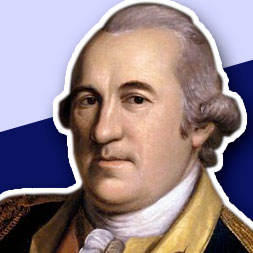
Baron von Steuben
2020 Icon
Revolutionary War General
b. September 17, 1730
d. November 28, 1794
“You say to your soldier, 'Do this' and he does it. But I am obliged to say to the American, 'This is why you ought to do this' and then he does it.”
Baron Friedrich von Steuben was a German-born American general and a hero of the Revolutionary War. Historians believe he was openly gay—a rarity at the time, especially for a military officer.
Born in Magdeburg, Germany, the son of an engineer lieutenant in the Prussian Army, von Steuben joined the military at age 17. He served as the personal aide to Frederick the Great, a gay monarch, in the Seven Years War (1756 – 1763), a world conflict that arose from the French and Indian War in North America.
In 1763, when von Steuben was an army captain, the military abruptly discharged him. Some scholars believe he was dismissed due to his homosexuality. He then worked for the German courts. In 1771 the Prince of Hollenzollern-Hechingen named him a baron.
Struggling financially in 1775, von Steuben tried unsuccessfully to join the French, Austrian and other foreign armies. When he learned that Benjamin Franklin was in France, he traveled there to offer his service to the American army fighting the British. He impressed Franklin with his knowledge of military order and discipline.
Von Steuben was eventually assigned to George Washington’s winter quarters in Valley Forge, Pennsylvania. Valley Forge functioned as the third of eight military encampments for the main body of the Continental Army.
With the help of translators, von Steuben taught the troops crucial military structure and tactics. Borrowing from his own strict Prussian Army training, he shaped the ragtag recruits and militiamen into organized, efficient fighters and boosted morale under the difficult conditions at Valley Forge. George Washington was so impressed, he extended von Steuben’s training to his entire command. He appointed von Steuben the first inspector general of the Army.
From January to October 1781, von Steuben served as a divisional commander under Washington in Yorktown, Virginia. The Yorktown campaign resulted in a decisive Franco-American victory and the start of peace negotiations. Many historians regard von Steuben as second only to Washington himself.
Although gay sex was a crime in the 1700s, same-sex romantic liaisons were tolerated. Von Steuben formed serious relationships with William North and Benjamin Walker. When the Revolutionary War ended, the U.S. granted von Steuben citizenship. He moved to New York, where he legally adopted both men, a practice commonplace among homosexuals, centuries before gay marriage.
When von Steuben died, North and Walker inherited his estate. The baron’s secretary, John Mulligan, with whom he was also believed to have had a relationship, inherited his library.
Von Steuben’s burial place became the Steuben Memorial, a state historic site in Steuben, New York.