2026 Icons
- Giorgio Armani
- Gabriel Attal
- Alvin Baltrop
- Frieda Belinfante
- Michael Bennett
- Rachel Crandall-Crocker
- Barry Diller
- Ernestine Eckstein
- Laïla El-Métoui
- Edward Enninful
- Andrea Gibson
- Marsden Hartley
- Muhsin Hendricks
- Patricia Highsmith
- Robert Joffrey
- Julie Johnson
- Lani Ka’ahumanu
- King James I
- Calvin Klein
- Abraham Lincoln
- Chris Pappas
- Pauline Park
- Paul Rudolph
- Amber Ruffin
- St. Vincent
- Jessica Stern
- Charles Sumner
- Jewel Thais-Williams
- Karl Heinrich Ulrichs
- Alok Vaid-Menon
- Edmund White
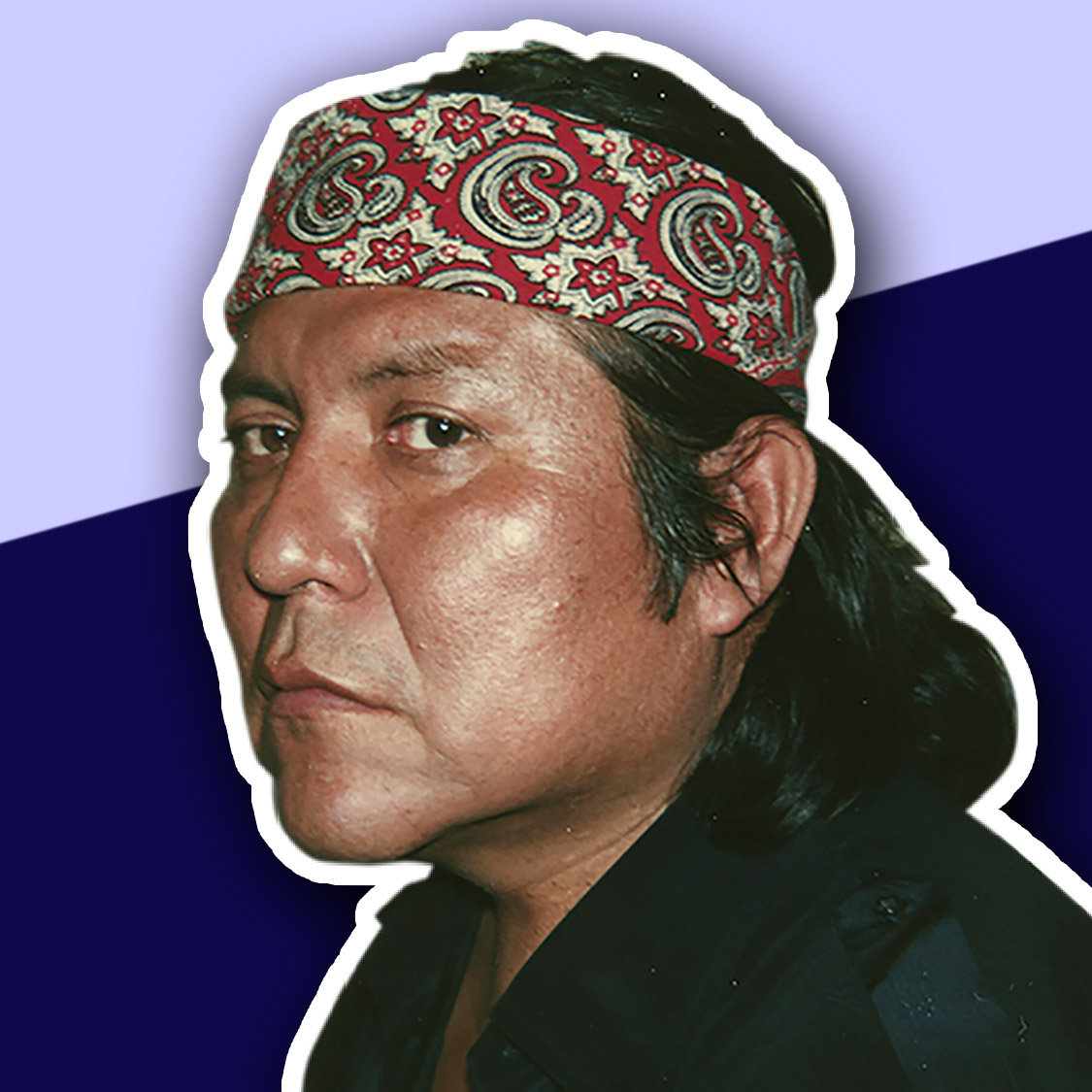
R.C. Gorman
2021 Icon
Native American Artist
b. July 26, 1932
d. November 3, 2005
“I’m an Indian painting Indians, and if it worked out for me, then it's all well and good.”
Rudolph Carl (R.C.) Gorman was a gay Native American artist best known for his paintings and lithographs of full-bodied indigenous women. The New York Times called him “The Picasso of American Indian Art.”
A member of the Navajo (Diné) Nation, Gorman was born in Chinle, Arizona, to a family “rich in artistic talent and creative spirit, but not in material possessions.” His mother was a devout Catholic. His father was a Navajo Code Talker and an accomplished artist and illustrator. They separated when Gorman was 12.
Gorman grew up with his extended family in a hogan, a traditional earth-covered dwelling. His grandmother, who served as his guiding light, nurtured his budding talent. To his mother’s dismay, Gorman’s earliest drawing portrayed a naked woman. He credits a high school teacher with the encouragement to become an artist.
Gorman briefly attended Arizona State College (now Northern Arizona University) before enlisting in the U.S. Navy in 1951. While stationed in Guam, he drew the wives and girlfriends of his officers and fellow sailors for a small fee, using photos for reference.
After the Navy, Gorman resumed his education. In 1958 the Navajo Tribal Council awarded him a scholarship to study art in Mexico City. There, celebrated painters such as Diego Rivera and David Alfaro Siqueiros significantly influenced his style and direction.
Upon his return, Gorman moved to the San Francisco Bay Area to start his career. Initially, he earned more money as an artist’s model.
Gorman embraced San Francisco’s gay culture and moved to the Castro District with his male partner. After an acquaintance outed him to his family, Gorman wrote home: “I am a homosexual. It’s unfortunate only in that I myself did not tell you.”
In the 1960s Gorman opened the country’s first Native-American- owned art gallery in Taos, New Mexico. Celebrity collectors, including Elizabeth Taylor and Gregory Peck, purchased his work.
Gorman’s success rested on his iconic representations of large, hardy, mostly Navajo women. “My women work and walk on the land …” he said. “ They are soft and strong like my grandmother.” Once, when asked about his subject matter, Gorman replied, “It’s me. I am every fat, nude woman I draw.” Traditional Navajo culture recognizes four genders and embraces the interplay of masculine and feminine.
Gorman received the Harvard University Humanitarian Award in Fine Art, the New Mexico Governor's Award of Excellence and multiple honorary doctorate degrees. When he died in Taos, the governor of New Mexico had flags flown at half-staff. The New York Times published Gorman’s obituary.