2026 Icons
- Giorgio Armani
- Gabriel Attal
- Alvin Baltrop
- Frieda Belinfante
- Michael Bennett
- Rachel Crandall-Crocker
- Barry Diller
- Ernestine Eckstein
- Laïla El-Métoui
- Edward Enninful
- Andrea Gibson
- Marsden Hartley
- Muhsin Hendricks
- Patricia Highsmith
- Robert Joffrey
- Julie Johnson
- Lani Ka’ahumanu
- King James I
- Calvin Klein
- Abraham Lincoln
- Chris Pappas
- Pauline Park
- Paul Rudolph
- Amber Ruffin
- St. Vincent
- Jessica Stern
- Charles Sumner
- Jewel Thais-Williams
- Karl Heinrich Ulrichs
- Alok Vaid-Menon
- Edmund White
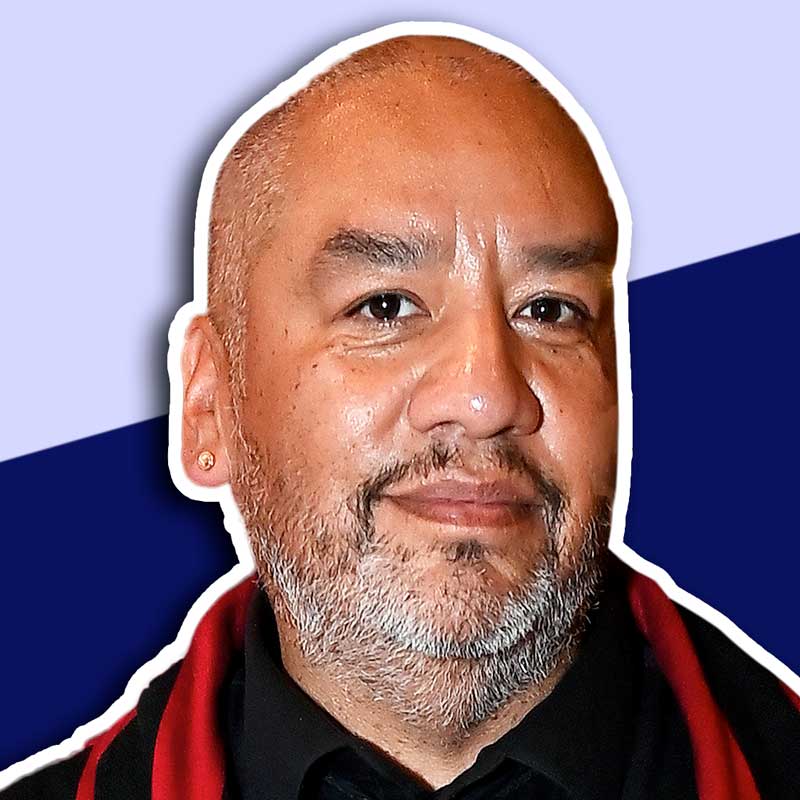
Jeffrey Gibson
2025 Icon
Jeffrey Gibson
Indigenous Artist & Sculptor
b. March 31, 1972
“I’ve thought of a lot of my work as being the call part of call and response. There’s sort of these calls to people … letting them know I’m here and that they should respond.“
Jeffrey Gibson is an award-winning multidisciplinary artist. Through a fusion of Native American craftwork, contemporary art, and queer iconography, he explores the complexities of identity.
Born in Colorado Springs, Colorado, Gibson is of Cherokee and Mississippi Choctaw descent. His father worked as a civil engineer for the U.S. Department of Defense, and the family lived in various countries during his childhood, including the United States, England, Germany, and South Korea.
After returning to the U.S., Gibson reconnected with his Native heritage and found a sense of community among other queer people of color. He earned a B.F.A. from the School of the Art Institute of Chicago in 1995. While in college, he worked at the Field Museum of Natural History, facilitating the return of Indigenous artifacts to their original tribes under the Native American Graves Protection and Repatriation Act (1990).
In 1998, with funding from the Choctaw Nation, Gibson received his master’s degree in painting from the Royal College of Art in London. The same year, he met a Norwegian artist, Rune Olsen. They married in Norway 14 months later.
The couple moved to New York City, and Gibson began his career as an artist. After years of modest success and self-doubt, he had a breakthrough in 2012 with his first solo exhibition, “one becomes the other.” The show, which exclusively featured sculpture and video, proved pivotal. It earned Gibson recognition for integrating traditional Native American crafts, such as beading and drum making, into his work and led to his first representation by a commercial gallery.
As his career progressed, Gibson’s work included his now-iconic beaded punching bags and other handwork referencing Native crafts, such as quilting, painting on rawhide, and totems. He also incorporated words and phrases into his art.
In 2024, Gibson made history as the first Indigenous artist to represent the United States with a solo exhibition in the American Pavilion at the 60th Venice Biennale. The exhibit showcased his signature pieces alongside new creations, such as beaded portrait busts.
Gibson’s work resides in countless prestigious collections, including the Whitney, the Smithsonian Institution, and the National Gallery of Art in Washington, D.C. He has received multiple coveted honors, such as the Joan Mitchell Foundation Painters and Sculptors Award (2015) and the MacArthur “Genius” Fellowship (2019).
Gibson lives and works in upstate New York and serves as an artist in residence at Bard College. He and Olsen have been married for more than 25 years. They have a daughter and a son.