2026 Icons
- Giorgio Armani
- Gabriel Attal
- Alvin Baltrop
- Frieda Belinfante
- Michael Bennett
- Rachel Crandall-Crocker
- Barry Diller
- Ernestine Eckstein
- Laïla El-Métoui
- Edward Enninful
- Andrea Gibson
- Marsden Hartley
- Muhsin Hendricks
- Patricia Highsmith
- Robert Joffrey
- Julie Johnson
- Lani Ka’ahumanu
- King James I
- Calvin Klein
- Abraham Lincoln
- Chris Pappas
- Pauline Park
- Paul Rudolph
- Amber Ruffin
- St. Vincent
- Jessica Stern
- Charles Sumner
- Jewel Thais-Williams
- Karl Heinrich Ulrichs
- Alok Vaid-Menon
- Edmund White
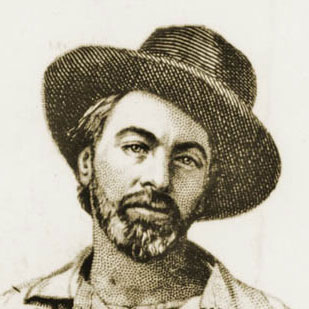
Walt Whitman
2006 Icon
Writer/ Philosopher
b. May 31, 1819
d. March 26, 1892
"I celebrate myself, and sing myself . . . "
Walt Whitman is considered by many to be America's greatest poet. He liberated poetry from the constrictions of European models and created a genuinely American style of verse. Best known for "Leaves of Grass," his groundbreaking volume of twelve untitled poems first published in 1855, which heralded a new, uniquely American style of poetry.
Whitman continued to revise and expand "Leaves of Grass" for the rest of his life. The first few editions were poorly received. "Leaves of Grass" was censured by some prominent American
intellectuals because of its innovative, unstructured verse and its celebration of sexuality, which they found obscene.
Whitman was born in Long Island, New York, into a Quaker family. Largely self-educated, Whitman supported himself as a printer, teacher, and journalist while he pursued his vision of a new form of literature that would express America's destiny as liberator of the human spirit. "Leaves of Grass" reflects Whitman's belief that poetry should be simple, with the natural rhythm of spoken language and without orthodox meter or rhyme.
During the Civil War, the poet served as an unofficial nurse in an army hospital, caring for his brother and other wounded Union soldiers at his own expense. When the war ended, Whitman, who was already internationally famous, remained in Washington, DC, working as a clerk in the Department of the Interior. However, when the Secretary of the Interior, James Harlan, discovered that Whitman was the author of "Leaves of Grass," Harlan fired the poet.
Whitman is widely considered to be the father of modern American literature, but during his lifetime he remained more highly regarded in Europe than in the United States. In 1882, Oscar Wilde, who was on a lecture tour of America, visited Whitman's at the poet's home in Camden, NJ. Afterward he said of Whitman, "He is the grandest man I have ever seen, the simplest, most natural, and strongest character I have ever met in my life."